PI Film Thickness vs. Total Stack Thickness: What to Specify
Separate the PI film, adhesive and liner in your material description, and identify which thickness applies to the intended laser operation.
THE PRACTICAL ANSWER
Specify the thickness of each known layer and define which layers are included in any total. Connect those values to the actual material code, incoming condition and requested cut. A single thickness value cannot describe every possible film construction.
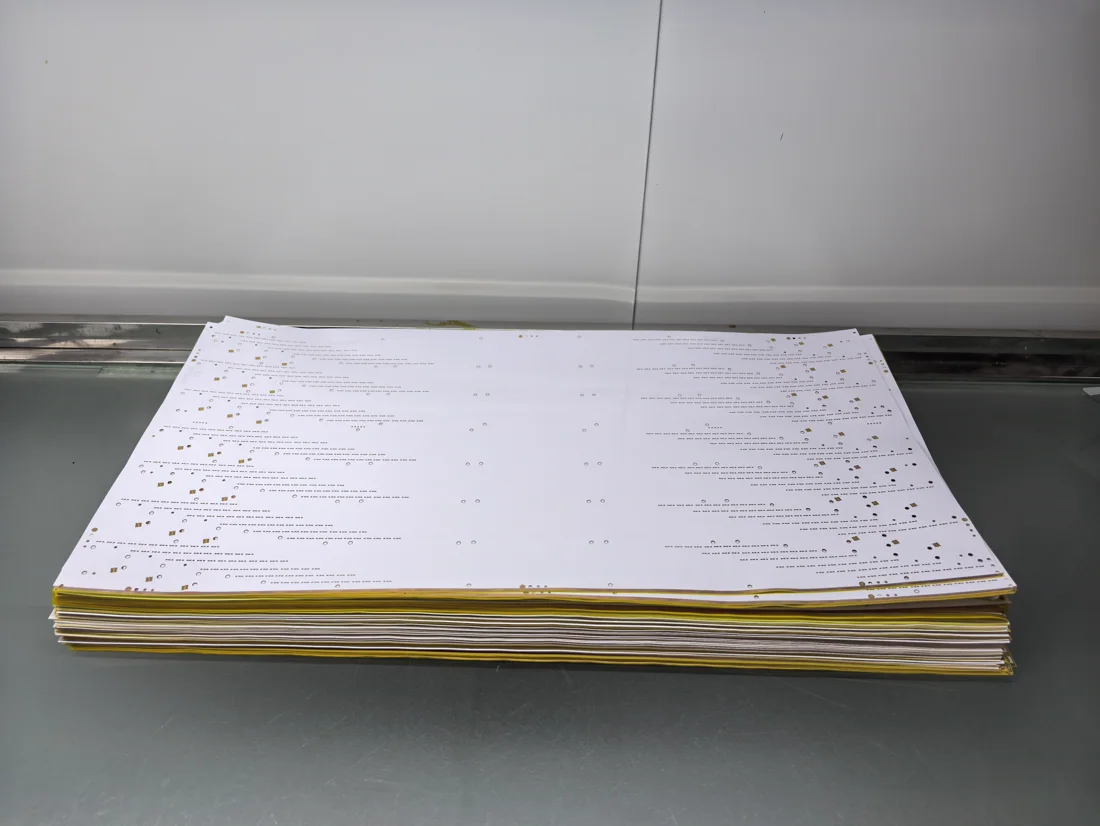
Define what the thickness refers to
A material description can refer to the PI film alone, the film together with an adhesive, or the complete incoming stack including a temporary liner or carrier. Those descriptions answer different questions. When a drawing says only “PI film, [thickness],” a reviewer still needs to know what is physically present during processing.
Start by identifying the supplied construction from one face to the other. Use the supplier product code and available documentation to distinguish an uncoated film from a coated or combined construction. Mark absent layers as absent and unknown layers as unknown; do not fill gaps by assuming that a familiar colour identifies a grade.
The manufacturer’s Pyralux LF coverlay data sheet provides one example of why this distinction matters: it describes a polyimide-and-adhesive construction and lists film and adhesive thicknesses separately. That product example is not a specification for every PI film supplied for cutting. For LF0210, Table 1 lists 25 µm of PI and 51 µm of adhesive. Specify any liner separately.
Record each layer before writing a total
| Field | What to record | Why it helps |
|---|---|---|
| PI film | Manufacturer, grade, thickness and units | Identifies the film rather than only a thickness number. |
| Adhesive, if present | Product identity and stated thickness | Separates the adhesive from the PI layer. |
| Liner or carrier, if present | Identity, thickness if known, and incoming state | Shows what accompanies the film during processing. |
| Other coatings or layers | Material description and available thickness information | Makes additional construction visible to the reviewer. |
| Total | Included layers, value, units and source | Prevents two different totals being treated as equivalent. |
If you calculate a total from stated layer values, label it as a calculated nominal total. Do not present it as a measured result. Identify any layer excluded from the calculation, especially a liner removed before a later assembly step.
Materials and process records
Two examples from processing records
The same “film thickness” field cannot describe both the base film and an adhesive stack. These recorded examples show why an enquiry should name each layer before giving a total. The values describe the stated constructions; they are not measured results for a new sample.
| Film layer (μm) | Adhesive (μm) | Film + adhesive (μm) |
|---|---|---|
| 12.5 | 15 | 27.5 |
| 25 | 25 | 50 |
For example, write “film: 12.5 μm; adhesive: 15 μm; film + adhesive: 27.5 μm”, or “film: 25 μm; adhesive: 25 μm; film + adhesive: 50 μm”. State any liner, carrier or coating separately, and identify which layers are present during cutting.
Keep nominal values and measurements distinct
A nominal value identifies a specified construction. A measured value describes a particular observation under a stated method and condition. The Kapton general specifications distinguish nominal thickness from thickness limits; this is a useful reminder to preserve the meaning of each value when preparing a material brief. Table 6 lists 100HN film at a nominal 25.4 µm, with thickness limits of 22.8–26.7 µm.
When supplying measurements, identify the sample, material state, method and units. Keep supplier thickness information alongside those observations instead of silently replacing one with the other. If two documents disagree, record the disagreement and ask which specification applies to the supplied stock.
A clearer enquiry description
Consider a drawing that states “adhesive-backed PI” without identifying whether the quoted thickness includes the adhesive. A useful revision would add the layer order, individual values where known, and the state in which the material will arrive. Use the example below to structure your material description.
| Less specific | More useful for review |
|---|---|
| “PI film, total thickness [value].” | “PI film [grade / thickness / unit] + adhesive [identity / thickness / unit]. The stated total includes these two layers.” |
| “Liner attached.” | “Supplied with [liner identity]. Liner thickness is [value / unit] or to be confirmed.” |
| “Cut the part.” | “Cut the defined profile through [named layers]. Requested condition of the liner: [requirement], subject to evaluation.” |
Connect the stack to the requested operation
Material description and processing intent belong together. Identify the reference face and state which layers are intended to be cut, retained or protected. A drawing of the finished film alone may omit a carrier present during the laser operation, so include an incoming-state sketch when it helps.
Retaining an underlying layer is a requirement to review on the actual construction. Neither a calculated thickness nor the appearance of a sample establishes that the requested result can be achieved. Use the material brief to define the question for a drawing review or sample evaluation.
Prepare these details for the next conversation
- Material manufacturer, product code and relevant document revision.
- Layer sequence, each known thickness and explicit units.
- The basis of each value: supplier information, calculated value or measurement.
- Incoming format, reference face and any liner or carrier.
- Layers to cut, retain or protect, with remaining questions clearly marked.
Use the material stack brief to organize these details. If the construction or requested retained layer needs physical review, continue to sample evaluation with the available drawing and material references.
Record thickness definitions and their sourcesTurn this into a preparation note.
Record known details and mark open questions. Copy the note or link it to your enquiry before leaving; edits are not saved after a reload.
Describe your actual material stack.
Connect this topic to the available material, drawing and requirements for your part.
References and scope
- Pyralux LF coverlay data sheet (PDF, p. 1, Table 1)
- Kapton general specifications (PDF, p. 5, Table 6)
Manufacturer documents provide the material examples cited above. They do not establish our processing limits. Use the applicable product specification for your actual supplied material.
Further project guidance: Describe your actual material stack. Material manufacture, coating, lamination, circuit fabrication and final assembly are outside the laser-processing service.