Flexible circuits and modules
Mark a pad, connector or sensor port that must stay open. Give the film-to-assembly datum and identify the coverlay or separate mask layer.
APPLICATIONS / PI FILM IN CONTEXT
Locate the flat film part inside your assembly. We review its cut geometry and film stack. The assembly drawing can show where an edge must clear a contact, port or connection.
Our service covers the agreed laser-processing operation on specified PI films and film stacks.
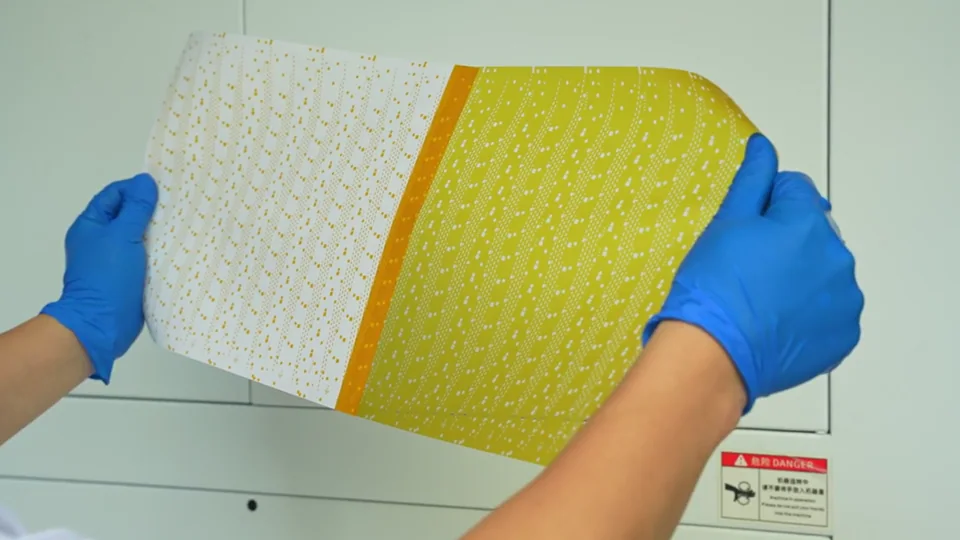
An application may involve several film parts. Use the areas below to identify the relevant geometry, then review the material, drawing and processing requirements for your project.
Mark a pad, connector or sensor port that must stay open. Give the film-to-assembly datum and identify the coverlay or separate mask layer.
Outline the insulation piece and the keep-clear area around a terminal. Specify the material grade and critical coverage. The assembly owner validates electrical performance.
Show where the film ends at a lead or mounting point. Specify which layer is supplied for cutting and which bonding or assembly steps your team handles.
01 / Flexible circuits
Start with the access regions in the circuit, then define the coverlay that surrounds them.
Pre-lamination coverlay is the primary starting point. Removing material from an already-laminated circuit needs a separate technical review, including underlying layers and protected areas.
Discuss your coverlay drawing02 / Electronics manufacturing
Connect an insulation or interface requirement to a clearly defined flat-film geometry.
The film grade and assembled product determine performance. Describe the intended interface and acceptance criteria rather than assuming that a cut shape alone establishes electrical insulation suitability.
Discuss your electronic assembly03 / Sensors & modules
Make the relationship between the film opening and the functional region explicit.
An opening geometry does not establish optical performance. Where light blocking matters, state the wavelength range and acceptance criteria; amber PI is not assumed to meet every optical requirement.
Discuss your module openings04 / Battery & power electronics
Define the coverage boundary around the connection area, including the regions that must stay clear.
These are drawing-defined film components. Internal cell separators, thermal-runaway protection systems and certified battery products are outside this service description.
Discuss your insulation geometry05 / Flexible heater assemblies
Identify the film layer before specifying the outline, lead exit or locating opening.
Pre-assembly film processing and processing a stack containing a heater element are different review cases. Complete heaters, resistive circuits, lamination and assembly are not supplied by this laser service.
Discuss your heater film layer06 / Automotive electronics
Start with the component requirement, then agree the project’s documentation and acceptance needs.
Application category alone does not establish automotive qualification. Raise required documentation, validation and approval processes during review so the achievable scope can be confirmed before commitment.
Discuss your project requirementsSELECT BY FUNCTION
Not sure which application area fits? Choose the closest film function to find a useful part-detail starting point.
FILM FUNCTION / 01
A coverlay opening has to relate to the flex-circuit layout. Describe the pad or contact region, registration references and incoming coverlay construction.
Review the pre-lamination versus already-laminated condition, adhesive and liner layers, and the required openings.
FILM FUNCTION / 02
Start with the mating components, the area to cover and any fastener or connector clearances. Specify the material separately from the geometry.
Review outer and inner dimensions, positioning features, thickness and application-specific acceptance criteria.
FILM FUNCTION / 03
Locate the sensing or access region relative to the film. Mark the windows, retained borders and orientation features.
Review window spacing, datums and required material or optical behavior. A geometry match is not an optical-performance approval.
FILM FUNCTION / 04
Identify the terminal or connection interface, coverage boundary and areas that must remain exposed or clear.
Review the installation area, construction, clearance requirements and who validates the assembled product.
FILM FUNCTION / 05
Identify whether the film acts as a cover or insulation layer and whether the incoming material already contains conductive features.
Review the complete stack, lead exits, locating features, target cut layers and protected regions.
FILM FUNCTION / 06
Define the outer contour, internal openings and every retained bridge. Identify whether the drawing describes one part or several disconnected pieces.
Review narrow borders, locating features, orientation, material stack and individual or retained-panel delivery.
This guide suggests a relevant page. Material suitability, dimensional requirements and the processing scope are evaluated for your actual project.
FROM APPLICATION TO OPERATION
An industry name is the beginning of the brief. The actual film, geometry and incoming construction determine which operation needs review.
For specified bare PI films or described existing constructions: outer profiles, internal openings, holes, slots and locating features. Define the removed regions and retained film.
Review PI film laser cuttingFor coverlay windows, contour and registration requirements. Describe PI, adhesive and liner layers and whether the coverlay is separate or already laminated to a circuit.
Review coverlay processingFor an uncertain material stack, cut depth, retained layer or assembled incoming part. Share the known details and questions so the processing request can be evaluated.
Discuss the processing scopeLaser processing only.Material manufacture, coating, adhesive application, lamination, circuit fabrication and final assembly are outside this service scope.
A CLEAR PROJECT ROUTE
Keep the functional requirement, processing requirement and final-product validation responsibilities connected through the review.
Explain where the film sits and which areas it must cover or leave clear.
Provide the grade, thickness and existing construction, including adhesives or conductors.
Define contours, openings, datums, retained layers and acceptance priorities.
Where agreed, assess the actual geometry and material against the project’s criteria.
Agree processing, inspection, quantity basis, delivery format and responsibilities.
BEFORE YOU ENQUIRE
Early-stage enquiries are welcome. Identify unknowns rather than replacing them with assumptions; the missing details can be discussed during review.
A sketch, annotated photo or short description showing where the film sits, its intended function and nearby components.
Part ID, revision, units, viewing face, film grade, thickness and complete layer construction. State the incoming condition.
Covered and clear areas, dimensions, datums, cut and retained layers, edge requirements and any project-specific validation needs.
Prototype or production enquiry; pieces, panels or sets; desired timing and delivery destination where known.
APPLICATION QUESTIONS
Choose the area that best explains where the film sits. The categories can overlap: an automotive sensor project may use the same basic geometry as another module mask. The drawing, material and acceptance requirements are more important than the category name.
No. Our scope is the agreed laser-processing operation on specified PI film or an existing construction accepted for processing. Circuit fabrication, lamination and final assembly are outside this service. The assembly illustrations provide context only.
Yes. Describe the installation area, intended film function, known material information and the geometry you are considering. Flag unknown details. Technical review can identify the information needed before a processing scope or quotation is confirmed.
No. A familiar application name does not establish material suitability. Provide the required electrical, thermal, optical, mechanical or environmental criteria as relevant. Material selection and assembled-product validation must be defined for the project.
This needs a separate review of the actual incoming construction. Identify all layers, conductive features, protected regions, the target removal and the surfaces that must remain unchanged. Acceptance for processing is not implied by the application examples on this page.
State the required drawing control, material records, inspection results, batch identification and approval process in the enquiry. The documents and checks that can be supported must be agreed for the project; this page does not claim automotive certification or a specific qualification package.
Where sampling is agreed, evaluate the processed film against the specified drawing, material construction and inspection criteria. Sample acceptance for a laser operation does not by itself validate the completed electrical or mechanical assembly. See sample evaluation for the project workflow.
Describe where the film sits, its role, the material and incoming construction, the desired geometry, quantity and project stage. Add drawing or photo references and the most important acceptance criteria. The application brief checklist provides a starting point.